
Where has all the creativity gone?
"The world is often unkind to new talent, new creations. The new needs friends." - Anton Ego, "Ratatouille"

It’s been a hot minute.
Well, more than a minute, actually, a few months since I last wrote here. I had envisioned this space as a twice-a-week review of the cultural scene, but life inevitably caught up. On this crisp early October morning, I find myself sitting in a café in Berlin’s Friedrichshain district with my morning coffee, reflecting on the exhibits I’ve visited and the fashion shows I scroll past online. And what strikes me most is how stale everything feels.

It’s not that I haven’t been out in the world. I’ve attended openings, shows, galleries, and even frolicked around department stores (Hallo KaDeWe!). But the climate in which culture is being produced feels uninspired. Worse, that lack of originality has become contagious, shaping not only what we consume but how we present ourselves.
Everything looks, or at least feels, the same. Sure, there are rare voices making waves, but by and large, the landscape feels flat, algorithm-ready, designed for social media sameness. Individual taste and style have been replaced by what “performs.” Scroll your feed, and you see it everywhere.
Cycles of sameness have always existed. Open any comprehensive art history textbook, and it will tell you so. But what worries me is how easily this sameness has been accepted, even embraced. We revere the work of boundary-breakers such as Freddy Mercury, Andy Warhol, Louise Bourgeois, Helmut and June Newton, and Gianni Versace, and we’ve seen the systems that elevated them. But today’s cultural climate nods to these predecessors only vaguely, without the same desire to push boundaries. Instead, it rewards safety.
Young artists and designers are rarely supported unless they guarantee sales. Ageism dismisses emerging talent as “inexperienced,” even when their training exceeds that of those running the show. Without the right connections or last name, many don’t even get a foot in the door. Nepotism has become the baseline.
Take September’s announcement that Jaden Smith, son of Jada Pinkett and Will Smith, would become Christian Louboutin’s first men’s creative director. The internet lit up. Critics questioning the appointment were dismissed as “jealous.” But it isn’t jealousy, it’s frustration. Countless designers have trained for years, scraping by for pennies, driven only by the need to create. Yet opportunity goes to someone with a famous family. The same pattern appears in the art world, where galleries often favor the safe, established, or the name that can garner attention, over new voices.
The fashion industry illustrates this well. A recent New York Times Style article asked, “Is Fashion Teetering on a Relevancy Brink?” The cover featured Saint Laurent’s Spring/Summer ’26 show. The article pinned the crisis different aspects including on rising prices, declining quality, and that the clothes aren’t bound to fashions most notable utalitarian quality. If fashion cannot be worn, which is arguebaly on the surface it’s sole function, what’s the point then? And yes, all of thos points are part of it. But the deeper problem is relevance, people don’t see themselves in fashion anymore just as much as people don’t see themselves in art anymore. The public that wants to go and consume are in many ways iced out.
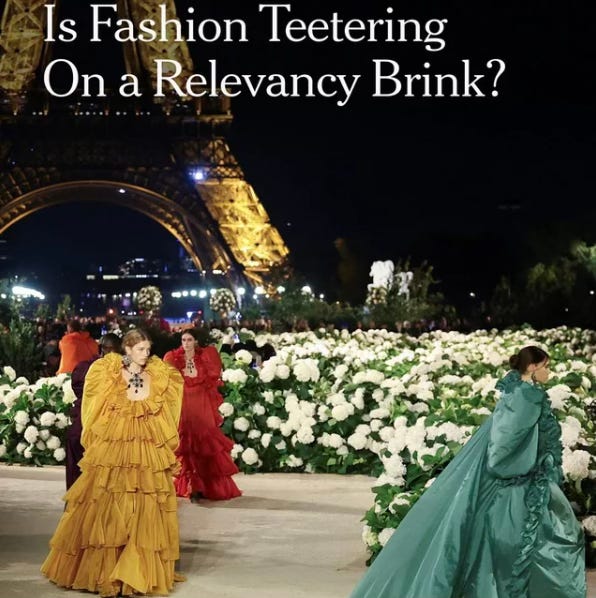
I once had a mentor, a leading fashion photographer from the 1980s and 1990s, who told me that models are essentially clothes hangers. Their job is to showcase the garment, not overshadow it. Consumers should be able to imagine themselves wearing the clothes. But Instagram culture has made models the main event. Faces like Kendall Jenner, Bella Hadid, or Amelia Gray dominate runways, and suddenly it’s no longer about the clothes. Most people can’t relate, let alone afford to replicate it. When fashion no longer helps us imagine ourselves, it becomes irrelevant.
The same dynamics apply in the art world. Big exhibits favor the safe, the known, the already-famous. Risk and individuality are pushed aside. Topics a broad demographic wants addressed are often ignored to appease a small, aging audience.
I was reminded of this at a recent event in Berlin. A marketing executive asked me why I studied art history, what the “practical” intention was. After fumbling for words, I said that if I were making the choice today, it would be for individuality. As a child, museums fascinated me because every artwork was different. In each room there were different bodies, aesthetics, beliefs, and visions of the world. That diversity was magical. And it still is, when harnessed correctly.
Somewhere along the way, we traded that individuality for sameness. Not because audiences demanded it, but because the system rewards it.
And that leaves me with a question I can’t shake:
If culture is supposed to reflect who we are, what does it mean that we’ve become so comfortable looking, and thinking, the same?